Claude for Predictive Finance Agents
Your agents give you answers. But who decides — and can you understand, approve, and change it? How a financial-services firm and its tech team stay in the loop with TAZI + Claude.
TAZI Team
Your agents give you answers. But who decides — and can you understand, approve, and change it?
How a financial-services firm and its tech team stay in the loop with TAZI + Claude.
Start here — what this paper builds on
• Claude for Financial Services gives you agents — ten finance templates that draft, reconcile, and prepare. They run workflows beautifully; they don’t predict. Anthropic · a great teardown by Yanli Liu (Medium)
• Self-service data analytics with Claude gives you fast, accurate answers about what already happened — descriptive, not a transparent, compliant predictive system. claude.com
• Preventing attrition with TAZI + Claude is the approach this paper extends — predictive models in TAZI, the conversation in Claude. TAZI blog · 2-min demo
You already know what an agent can do. It can pull your numbers, draft an email, reconcile a ledger, prepare a meeting. That is real, and it is useful. But notice what it is not doing: it is not predicting anything. It does not tell you which customer is about to leave, which transaction is likely fraud, or which account an auditor should pull — and why — and stand behind that answer.
Self-service analytics has the same shape. It answers “what happened” quickly and accurately. That is description, not prediction — and it is not a transparent, governed system that makes decisions about real people and lets you act on them.
That gap is what TAZI and Claude close together. The important part for you: the decision is made by a machine-learning model that is documented, explainable, and monitored. Claude is how you and your team talk to it, question it, approve it, and change it. You are in the loop — and everything you see is something you can understand, approve, and update.
1. What you see: one conversation
Start where the work happens — with a frontline user. A relationship manager at a bank, a fraud analyst at an insurer, an auditor at a credit union — each opens Claude, picks the skill for the job (Retention, Fraud, or Audit), and simply asks questions. Behind every answer is a TAZI model trained on the firm’s own data.
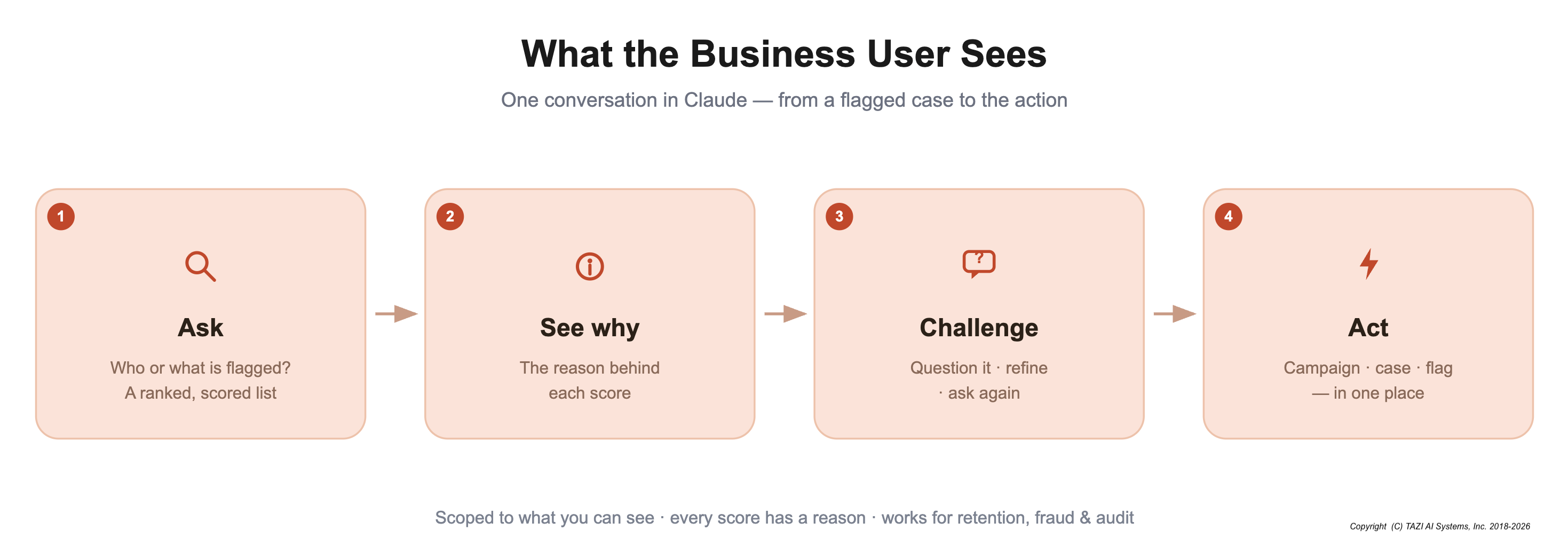
Press enter or click to view image in full sizeFigure 1 — What the business user sees: open a flagged case, ask why, challenge it, then take the action — all in one conversation.
Figure 1 — What the business user sees: open a flagged case, ask why, challenge it, then take the action — all in one conversation.
The loop is simple, and the user never leaves the conversation:
• Who or what is flagged? A ranked list of customers, accounts, or cases — each with a score.
• Why this one? Plain-language reasons behind the score — every number traces back to the model.
• I don’t buy it. The user can challenge the model, refine, and ask again.
• Take the action. Once satisfied, launch a retention campaign, open a fraud case, or flag an audit exception — in the same window.
Three things the user never has to worry about, but always gets: scoped access (only the records they’re allowed to see), a reason for every score (grounded in a governed model, not a guess), and one place to go from insight to action.
The same conversation works whether the job is retention, fraud prevention, or audit — across wealth, banking, and insurance. Only the skill and the data change; the experience does not.
2. What your tech team sees — and does
“Trust the model” is easy to say. It holds up only if the people who run your business can see how the model is built, approve it, and change it when something moves. That is what your tech team’s view is for.
Press enter or click to view image in full sizeFigure 2 — What the tech team does: the agents do the work; your team decides and signs off.
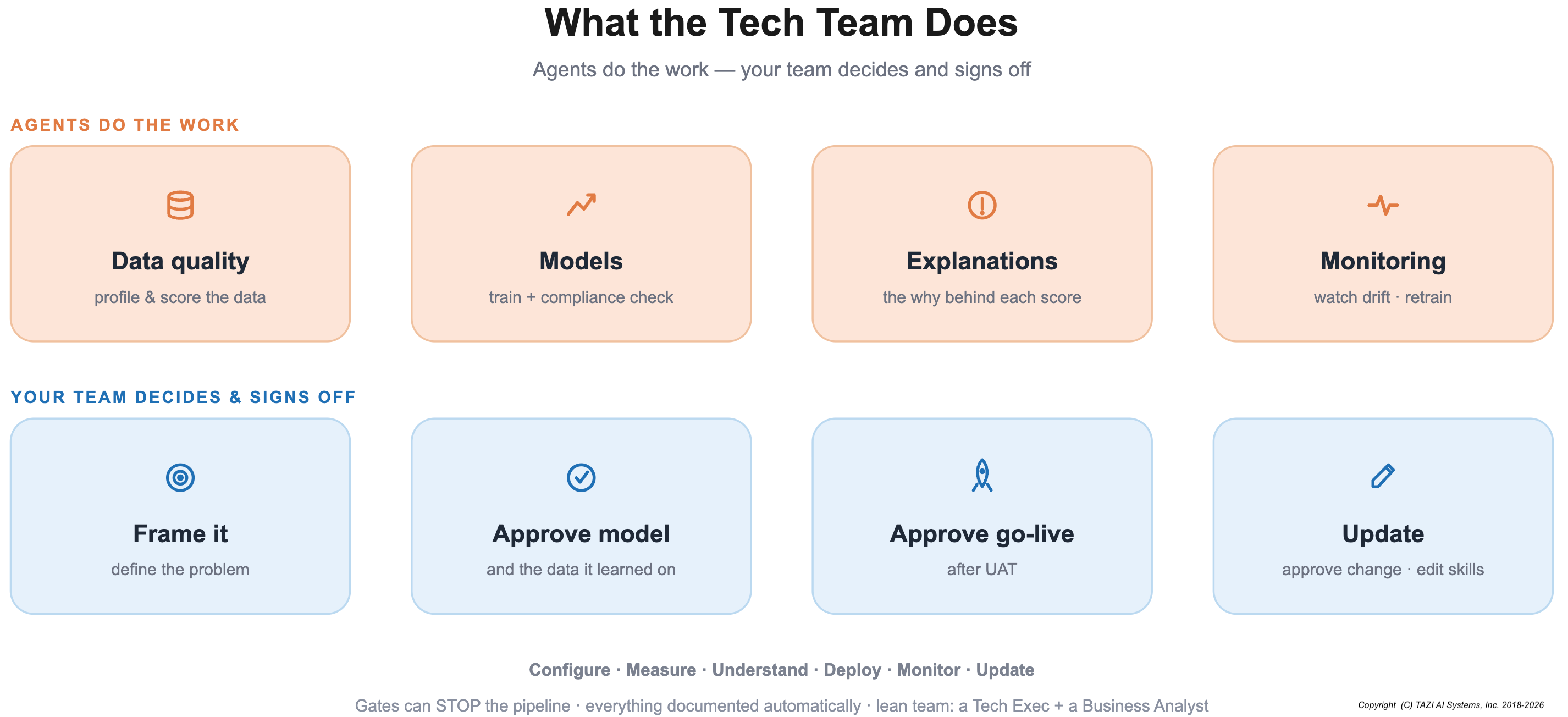
Figure 2 — What the tech team does: the agents do the work; your team decides and signs off.
Read it as a simple lifecycle: Configure → Measure → Understand → Deploy → Monitor → Update. For each stage there are two lanes.
• The agents do the work (the orange cards): profile the data, train the models, explain every score, run the fairness audit, watch for drift, and write the documentation.
• Your team owns the decisions (the blue cards): define the problem, sign off that the data is fit, approve the model, approve go-live, handle escalations, approve a retrain.
Two details matter for staying in control. First, the gates — a data-quality gate and a compliance gate that can STOP the pipeline before a bad dataset or a non-compliant model ever reaches production. Second, everything is documented automatically: the compliance document, the fairness audit, the monitoring plan, the change records — all written by the pipeline as it runs. Your team reviews and signs; the system does the writing.
And the team stays lean. In this example it’s just two people: a Tech Exec (executive plus director) who frames the problem and approves the model and go-live, and a Business Analyst (covering data science and engineering) who delivers data, runs UAT, and edits the skills directly — no rebuild, no waiting on the vendor. TAZI’s AI Engineer builds and maintains the automated layer, but the day-to-day is yours. When you have a better idea, you change it.
3. What the agents actually do, under the hood
You don’t need to know this layer to use the system — but it’s worth seeing once, because it explains why the answers are trustworthy. This is the machinery behind the two views above. It might look overwhelming, but it shows that modeling for production is not a trivial task.
Press enter or click to view image in full sizeFigure 3 — Under the hood: the model makes the decision; agents keep it accurate, compliant, and current; the conversational layer is where you talk to it.
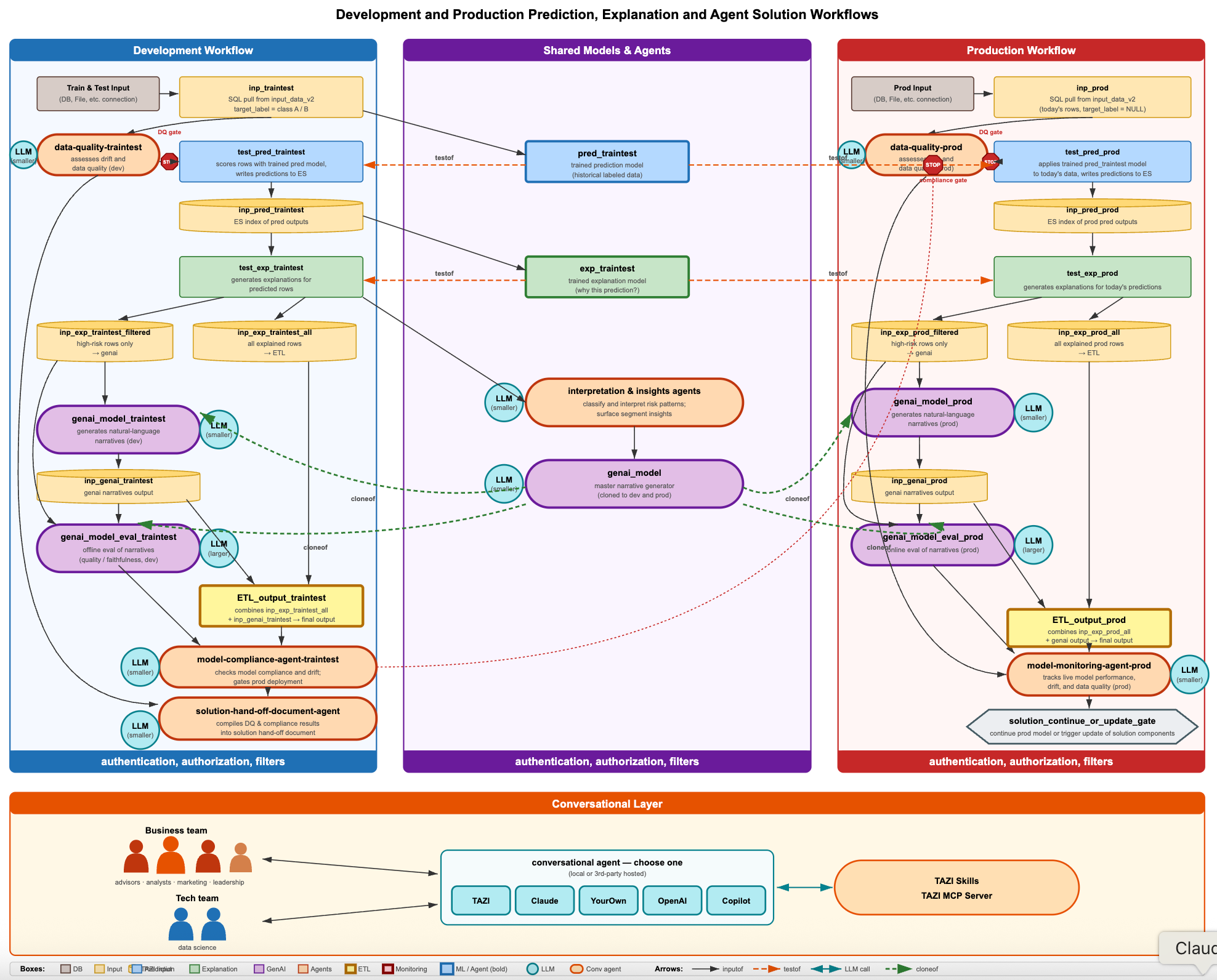
Figure 3 — Under the hood: the model makes the decision; agents keep it accurate, compliant, and current; the conversational layer is where you talk to it.
The key idea is the division of labor:
• The prediction model decides. It produces the score — who’s likely to leave, which transaction looks fraudulent, or which case to review.
• The explanation model says why. Every score comes with its reasons, in language a person can read.
• The agents guard the model. Data-quality, interpretation, compliance, and monitoring agents check the inputs, surface the patterns, enforce the rules, and watch for drift.
• The conversational layer is where you live. It sits on top of the explanations and narratives — that’s the one conversation from Figure 1.
Notice the agents are not the ones making the call. The machine-learning model makes the decision; the agents make that decision more accurate, keep it compliant, and let it be upgraded when — not if — something changes.
The takeaway
Decision = the model. Accuracy, governance, and upkeep = the agents. Understanding, approval, and change = you and your team.
You get predictive answers you can act on, a reason behind every one, a tech team that approves and governs it, documentation written for you, and the freedom to change it when you have a better idea. That is what “Claude for predictive finance agents” means — and why you stay in the loop the whole way.
See it in action: youtu.be/t33Qn-cHLqA · or on your own data: tazi.ai/request-a-demo