From AI Users to AI-Enabled Market Makers
TAZI Team
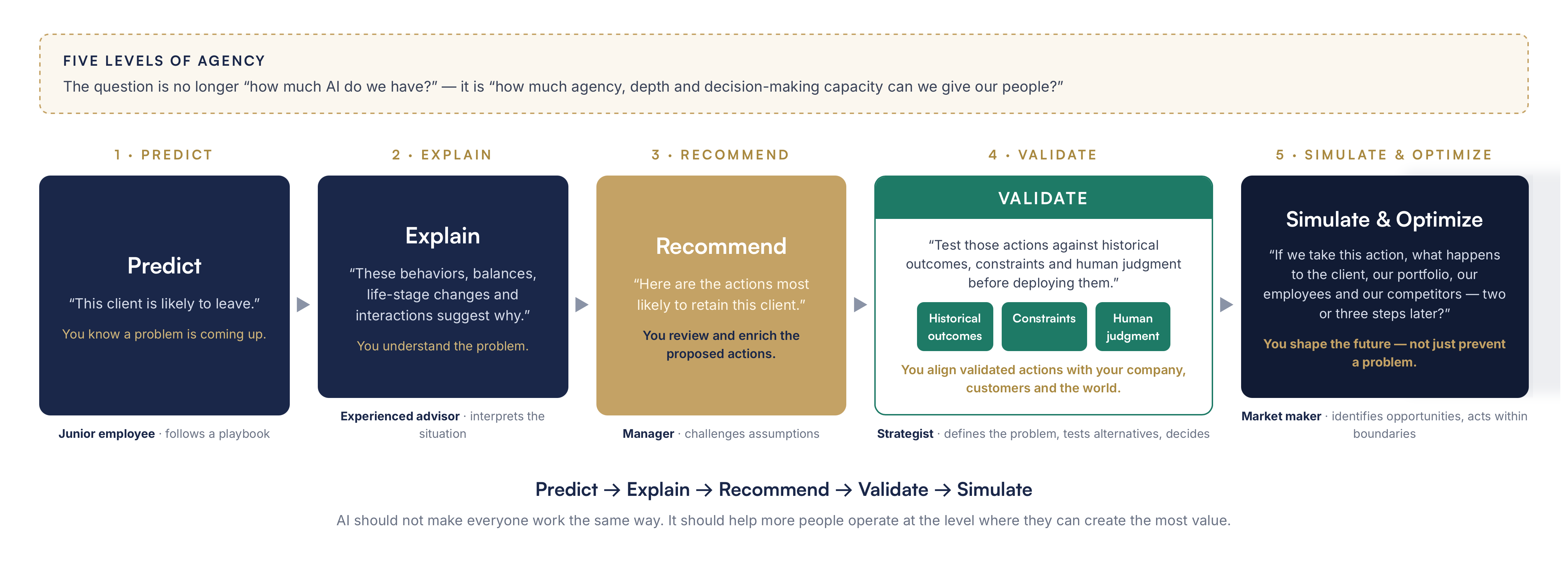
People have been working in different “AI engagement modes” long before AI existed.
A junior employee follows a playbook.
An experienced advisor interprets the situation.
A manager challenges assumptions.
A strategist defines the problem, tests alternatives, and decides where to act.
Their differences come from skills, experience, authority, incentives, role—and the tools available to them.
AI can either reinforce these differences or flatten them.
Consider client attrition in wealth or retail banking.
At the simplest level:
1. Predict
“This client is likely to leave.”
You know that there is a problem coming up.
Better:
2. Explain
“These behaviors, balances, life-stage changes and interactions suggest why.”
You understand the problem and may be able to think of some actions to solve it.
Better still:
3. Recommend
“Here are the actions most likely to retain this client.”
You review and enrich/update the proposed actions so that they align with you as a human and your company, customers and the world.
Then:
4. Validate
“Test those actions against historical outcomes, constraints and human judgment before deploying them.”
You review and enrich/update the validated actions so that they align with you as a human and your company, customers and the world.
And further:
5. Simulate and optimize
“If we take this action, what happens to the client, our portfolio, our employees and our competitors? What if they respond? What happens two or three steps later?”
You plan on what to do to shape the future at a higher level, not just taking actions to prevent a problem.
These are very different levels of effort, representation and agency.
The same client can therefore be represented at very different depths.
At one level, the bank sees:
$2M AUM → High-value client → Retention campaign
At a deeper level, it sees:
$2M AUM + liquidity trend + life stage + risk profile + relationship history + unmet needs + advisor capacity + competitor activity + market conditions + likely response to alternative actions.
And the employee can also be represented at different depths:
Advisor → 200 clients
versus:
Advisor capacity + expertise + relationships + current workload + performance + authority + likely effectiveness with this client.
The company, the client, the employee, the market and competitors all become parts of the system.
That changes segmentation.
Instead of putting thousands of people into the same segment and treating them identically, we can differentiate based not only on net AUM, but on the situation surrounding each decision.
This also changes the role of technology.
At one level, technology helps employees serve products.
At another, it helps them serve situations.
At the highest level, it can help authorized employees become active market makers—people who can identify opportunities, propose and validate actions, understand the consequences, and act within clearly defined boundaries.
And authority does not have to be centralized.
A company can distribute decision-making across employees and AI systems while maintaining common KPIs, controls, constraints and learning loops.
Please see more details here on how the validated action agents work:
Ship Validated Actions, Not Models — TAZI AI
Simulation layer is nothing but running this whole loop with simulated data for different future conditions data, instead of actual data of the past. Not just “what should we do with this client?” but “what happens to our whole system—and the competitor’s system—if we do it?”
Think a few steps ahead.
The interesting question is no longer:
“How much AI do we have?”
It is:
“How much agency, depth and decision-making capacity can we give our people?”
AI should not make everyone work the same way.
It should help more people operate at the level where they can create the most value.
Want to test a client retention agent or other agents that could help you see the results of your potential actions in advance and decide a few steps ahead?
Please email us at info@tazi.ai.
See also:
how to use agents to be better at your job: x.com/brianroemmele
how to talk with agents as an SME: seangoedecke.com/llms-reward-expertise