Focus Group Agent to Optimize Actions
TAZI Team
TAZI Focus Group Agent to understand consequences and to approve actions
When an AI agent makes a decision, very little of the work is visible to the person watching it. The agent loops with its harness — the wrapper that gives it tools, memory, and permissions — across many turns of reasoning and tool calls before it ever presents the action it wants to take. (For a primer on what that wrapper actually does, see Firecrawl's explainer on agent harnesses.) What the human eventually sees is a recommendation: send this offer, change this price, route this case, contact this client.
And here's the honest problem: we cannot expect a person to meaningfully approve that action by reading a summary of it. The industry has a name for what happens when we try — the rubber-stamp problem. As multiple analysts have argued through 2026, when "human in the loop" means click approve on what the model already decided, oversight becomes theatre rather than judgment. The reviewer doesn't have the time, the context, or the counterfactual to push back. So they approve.
This isn't a flaw of agentic AI. It's the missing step in front of it.
What humans actually need before they say yes
To genuinely approve an action, a person doesn't need a prettier summary. They need to see how the people on the other end of the action would respond. If we send this retention offer, who would take it? Who would resent it? Who would do nothing? What's the optimal version of this message for each of those groups? That's the question worth answering before an agent ships anything — whether the action is a product offer, a price change, an email subject line, an onboarding nudge, a fee waiver, a workflow change, you name it.
That question has, until now, lived in two unsatisfying worlds. One is real research, which is honest but slow and expensive: a study a quarter, after the launch. The other is "synthetic users" that drift agreeable, smooth over disagreement, and quietly tell you what you already wanted to hear. Neither closes the loop in the place that matters: the moment just before a human approves an agent's action.
What the Focus Group does
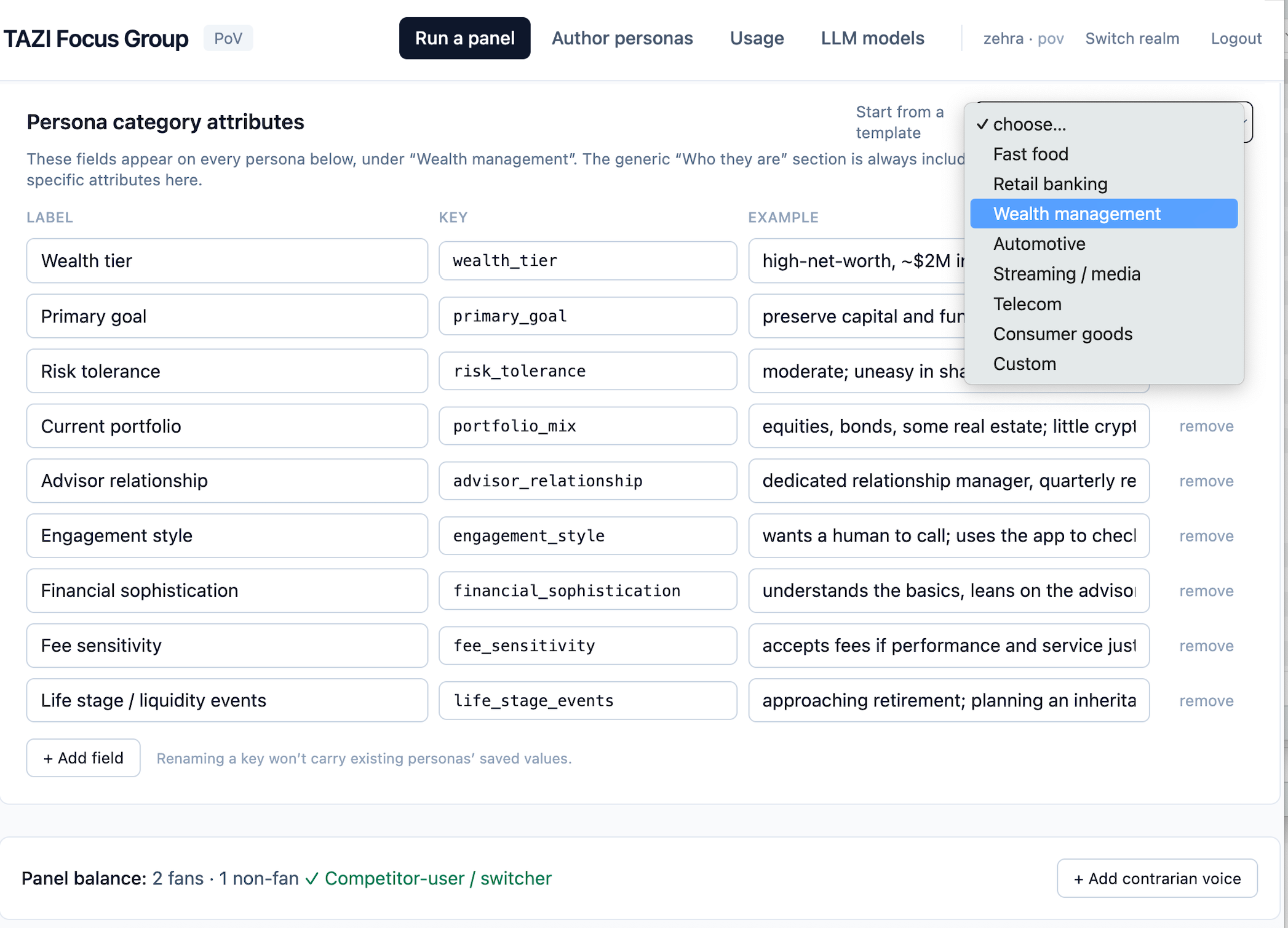
TAZI Focus Group is exactly that missing step. It's a simulation environment, controllable and iterable by a business user, where you build a panel of customers, present them with a candidate action, and see — in plain language and in segments — how they would respond, what would change their minds, and what the optimal version of the action looks like for each group.
The personas in the panel aren't shallow demographics. They're modeled on what your business actually has:
- Demographic and segment data — the attributes you already use to describe your customers.
- Predictive models — the behavioural patterns TAZI's RETAIN, GROW, ACQUIRE, ATO and VoC agents already learn from your customer history. The same model that predicts who's likely to churn, or who's ready to deepen a relationship, can stand up as a persona of that customer in the panel.
- Generative models — for filling in how those customers might react to circumstances they haven't been in yet: a new tier, a new offer, an unfamiliar message, a price change. This is where Focus Group goes beyond historical data into what would happen if.
The result is a panel that resembles your real book of business, not a generic crowd — and that argues back the way real customers do.
A simulation environment you control
Crucially, Focus Group is not a black box you query once. It's an environment a business user can drive and iterate on:
- Tune the panel — adjust who's in the room and in what proportions.
- Try variants of the action — three versions of the same offer; two prices; five subject lines; four channels.
- Rerun and compare — see which version moves which segment, and where you'd lose people.
- Lock in the version you'd be willing to approve — and only then take it to the agent that will act on it.
Around RETAIN, GROW, ACQUIRE, ATO and VoC, this is the rehearsal room: Focus Group is where you decide what's worth approving; the Enterprise Agent is where it gets done.
What Focus Group returns
Every run produces three things:
- Emergent segments of how the panel actually reacted — re-derived from what was said, not read off an answer key.
- A motivation × behaviour view — the why a group reacted that way, linked to the what they did.
- 3–5 concrete next steps — including the recommended version of the action and which segments it leaves behind.
And every run ends with the same line: this is a simulation to make your judgment sharper before you commit — not a survey, not statistically representative, not a prediction. The point isn't to skip real research. The point is to make sure the human in the loop is actually in the loop.
Why it matters now
Agentic AI is moving from advisor to actor — agents now take hundreds of operational actions a day inside the enterprise, far past anyone's ability to read each one carefully. The fix isn't to stop the agents. It isn't to add more approval buttons either. It's to give the humans something worth deciding on: a controllable preview of how customers would respond, before the action gets sent.
That's what Focus Group is for.